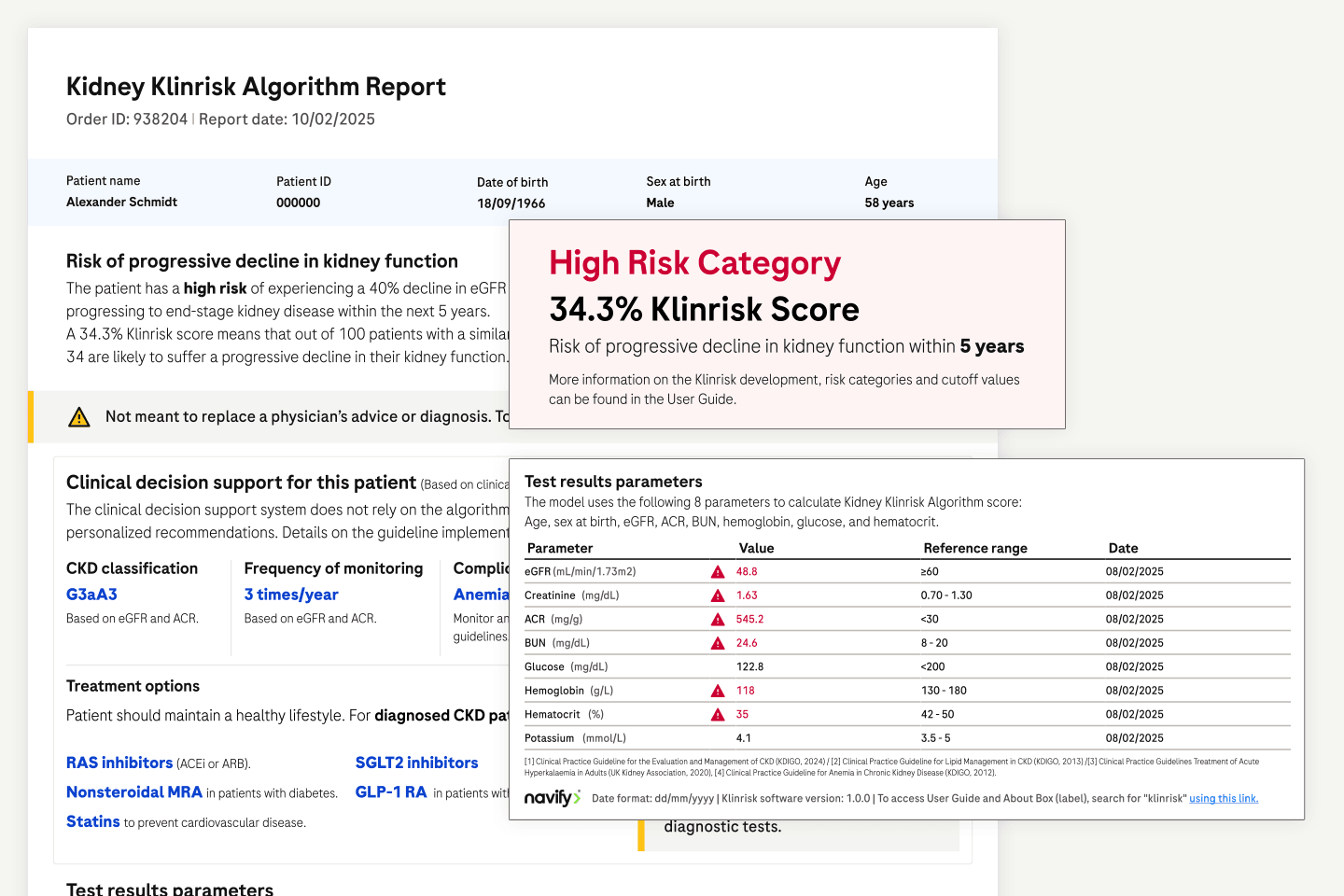
The clinical performance of the Kidney Klinrisk Algorithm was evaluated through external validation in a retrospective, non-interventional study using secondary data from the Stockholm CREAtinine Measurements (SCREAM) project. SCREAM is a large, population-based registry that contains comprehensive healthcare data on more than 2 million individuals in the Stockholm region of Sweden.4
The study cohort included 10,434 adults aged 18 and older. Historical data spanned from January 1, 2007, to December 31, 2019, with follow-up data available through December 31, 2021.5
The study validated the algorithm’s ability to effectively stratify patients at risk for kidney function decline, dividing patients into high, moderate, and low-risk groups using precise 5-year Kaplan-Meier estimates. The Algorithm demonstrated strong predictive performance with an Area Under the ROC Curve (AUC) of 0.844 (95% CI 0.829–0.859), a Brier Score of 0.124 (95% CI 0.120–0.128), 96.01% (95% CI 94.87–97.16) sensitivity, and 76.02% (95% CI 73.70–78.35) specificity.5
The algorithm proved robust performance across diverse populations, CKD stages, and clinical scenarios. It notably enhances risk stratification within the KDIGO "green" category by identified more cases and outperforming current standards (KDIGO heatmap based on eGFR and uACR). The algorithm's robustness is further supported by its consistent performance when employing different commonly used eGFR equations, offering flexibility in clinical application.5